The Wine Routes of Europe · Route 10
Greece — Peloponnese & Central
The Mainland Vines — Agiorgitiko, Moschofilero & Mountain Terroir
The Route
The Mainland Vines — Agiorgitiko, Moschofilero & Mountain Terroir
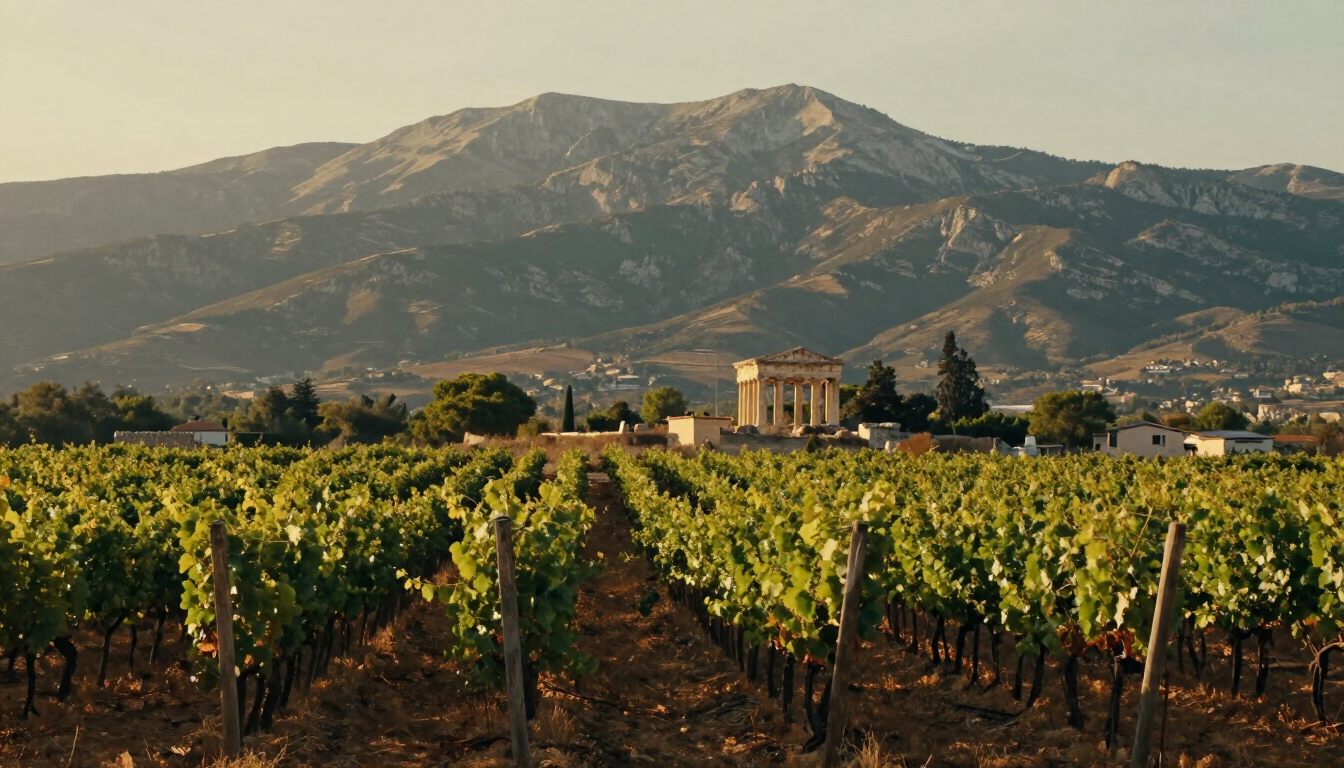
Greece is far more than its islands. The Peloponnese holds the valley of the country's flagship red — the 'blood of Hercules' — and a mountain plateau where high-altitude vines make some of the most aromatic whites in the Mediterranean, wrapped in the greatest ancient sites in Europe.
A History in the Glass
Greece — Peloponnese & Central, across the centuries.
This is where European wine writing begins. Clay tablets from the Bronze Age citadels of the Peloponnese record deliveries of wine in an early Greek script — among the oldest written wine records on the continent, made while the citadel walls were still new. The valley that produces the region's great red has been associated with wine since antiquity, and hosted one of the four Panhellenic games of the ancient world; its grape is nicknamed for the blood of the lion Hercules killed there.
For the classical Greeks, wine was civic infrastructure: traded in amphorae stamped with their city of origin, mixed with water as a mark of civilisation, and central to religion, medicine and philosophy. Greek colonists carried vines west to Sicily, southern Italy and Marseille — meaning that Italian and French wine both descend, in a real sense, from this coastline.
What followed was a long eclipse: Roman absorption, Byzantine monastic continuity, four centuries of Ottoman rule, and then a twentieth century in which Greek wine became known abroad chiefly for resinated white sold cheaply. The recovery is a single generation old. Producers trained in France and Germany returned in the 1980s and 1990s, chose the native varieties over international ones, and moved into the mountains for altitude and freshness. The mainland is still the least-discovered part of that story.
Sommelier Notes
The Peloponnese holds Europe's oldest written wine records — Linear B tablets from the Bronze Age. Tasting Agiorgitiko, the 'blood of Hercules', minutes from the citadel where those tablets were found, gives the wine a depth no other region can claim.
Head Sommelier — Greek mainland programme
Mantinia's plateau sits above six hundred metres, producing floral, high-acid whites in a famously hot country. Moschofilero — a pink grape that makes white wine — is the curiosity our guests still ask for by name long after they return home.
Wine Director — Private client travel
Interesting Facts
- ◈
Bronze Age Linear B tablets from the Peloponnese record wine deliveries — among Europe's oldest written wine records.
- ◈
Agiorgitiko is nicknamed the 'blood of Hercules', after the Nemean lion of the legend.
- ◈
The valley of that grape hosted one of the four Panhellenic games of the ancient world.
- ◈
Mantinia's vineyards sit on a plateau above 600 metres, producing floral, high-acid whites in a famously hot country.
Things That Make This Region Extraordinary
Six reasons this route is unlike any other.
Bronze Age Linear B tablets from the Peloponnese record wine deliveries — among Europe's oldest written wine records.
Agiorgitiko is nicknamed the 'blood of Hercules', after the Nemean lion of the legend.
The valley of that grape hosted one of the four Panhellenic games of the ancient world.
Mantinia's vineyards sit on a plateau above 600 metres, producing floral, high-acid whites in a famously hot country.
Moschofilero is a pink-skinned grape that makes white wine — and occasionally a rosé-tinted one.
Greece has roughly three hundred indigenous grape varieties, most of them grown nowhere else on earth.
Ancient Greek colonists carried vines to Sicily, southern Italy and Marseille — the ancestors of Italian and French wine.
In the Glass
What you will be drinking.
The country's flagship red in every register, from bright and juicy to deep and age-worthy; aromatic, floral, high-acid whites grown at altitude; and on the coast, modern, outward-looking wines from native and international varieties side by side.
Grapes
Agiorgitiko + Moschofilero
Character
Mountains + ancient sites
Greek colonists carried vines from this coastline to Sicily, southern Italy and Marseille — Italian and French wine descend, in a real sense, from here. Telling that story among the vines of Nemea is the strongest case for Greek wine we can make.
Cellar Master — Nemea vertical tasting
The Journey
How the days unfold.
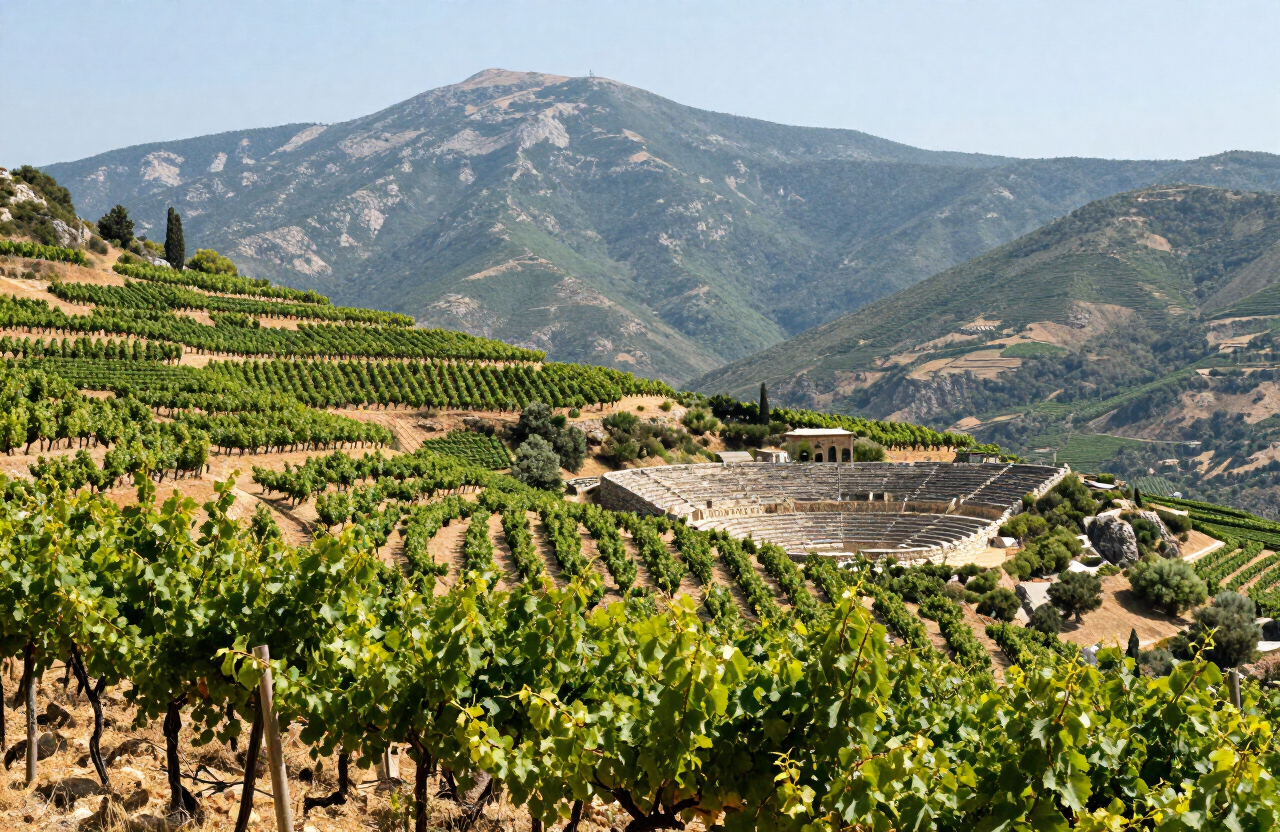
Compact and scenic, looping out of the capital: the red valley and its Bronze Age citadel minutes from the vines, the cool green plateau of the mountains, a coastal estate by the sea, the finest acoustics of the ancient world at a nearby theatre, and a final relaxed day in an elegant Venetian-Ottoman seaside town.
Best suited to
Culture-and-wine groups
Duration
6 days / 5 nights
When to go
May–Jun · Sep–Oct
More to know
Further facts from the route.
Moschofilero is a pink-skinned grape that makes white wine — and occasionally a rosé-tinted one.
Greece has roughly three hundred indigenous grape varieties, most of them grown nowhere else on earth.
Ancient Greek colonists carried vines to Sicily, southern Italy and Marseille — the ancestors of Italian and French wine.
Continue exploring
The other nine routes across Europe.
Begin here
Your Greece — Peloponnese & Central journey, designed privately.
Tell us the route, the group and the season. We return a complete private itinerary within 48 hours.