The Wine Routes of Europe · Route 01
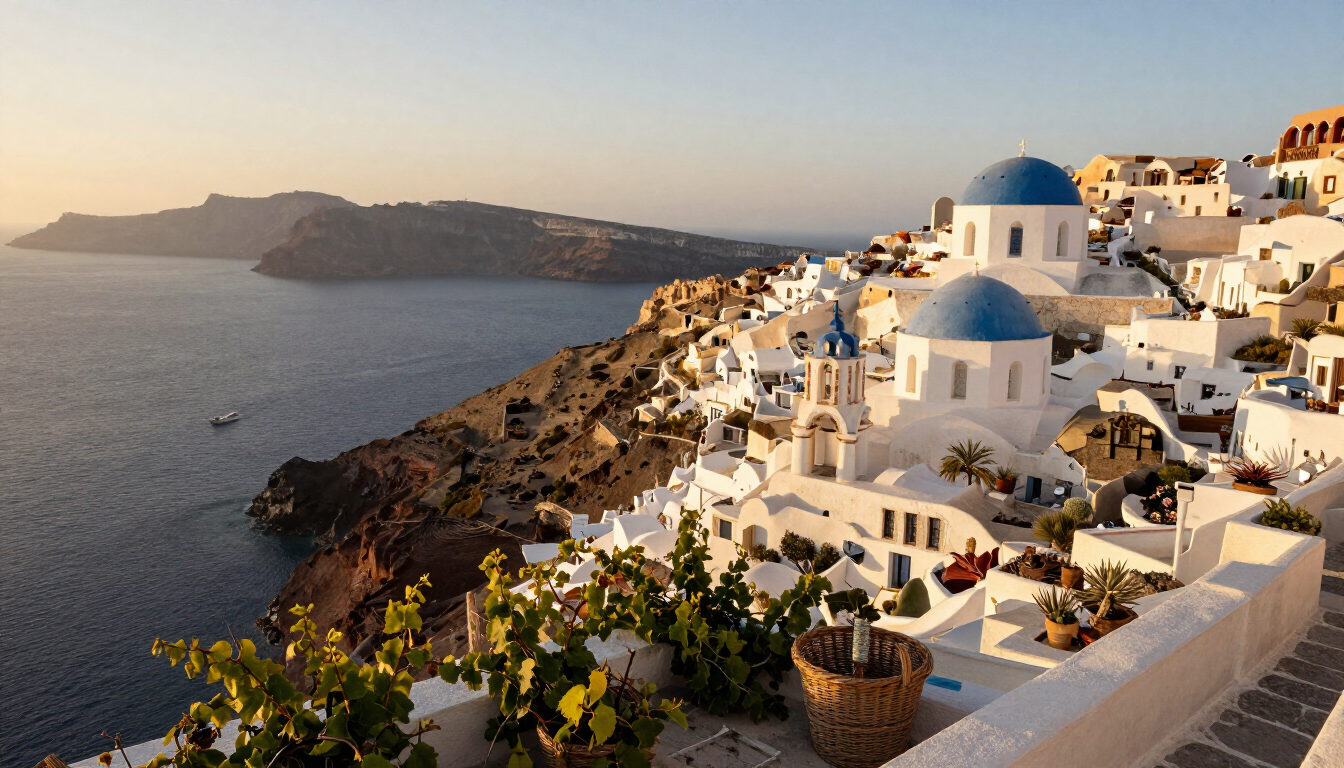
Crete + Santorini
Volcanic & Ancient — The Cretan-Cycladic Wine Route
The Route
Volcanic & Ancient — The Cretan-Cycladic Wine Route
Two entirely different stories in a single journey: the deep mountain terroir and family hospitality of Crete, and the volcanic austerity of Santorini — where vines are woven into baskets on the ground and grow in ash that has never known phylloxera.
A History in the Glass
Crete + Santorini, across the centuries.
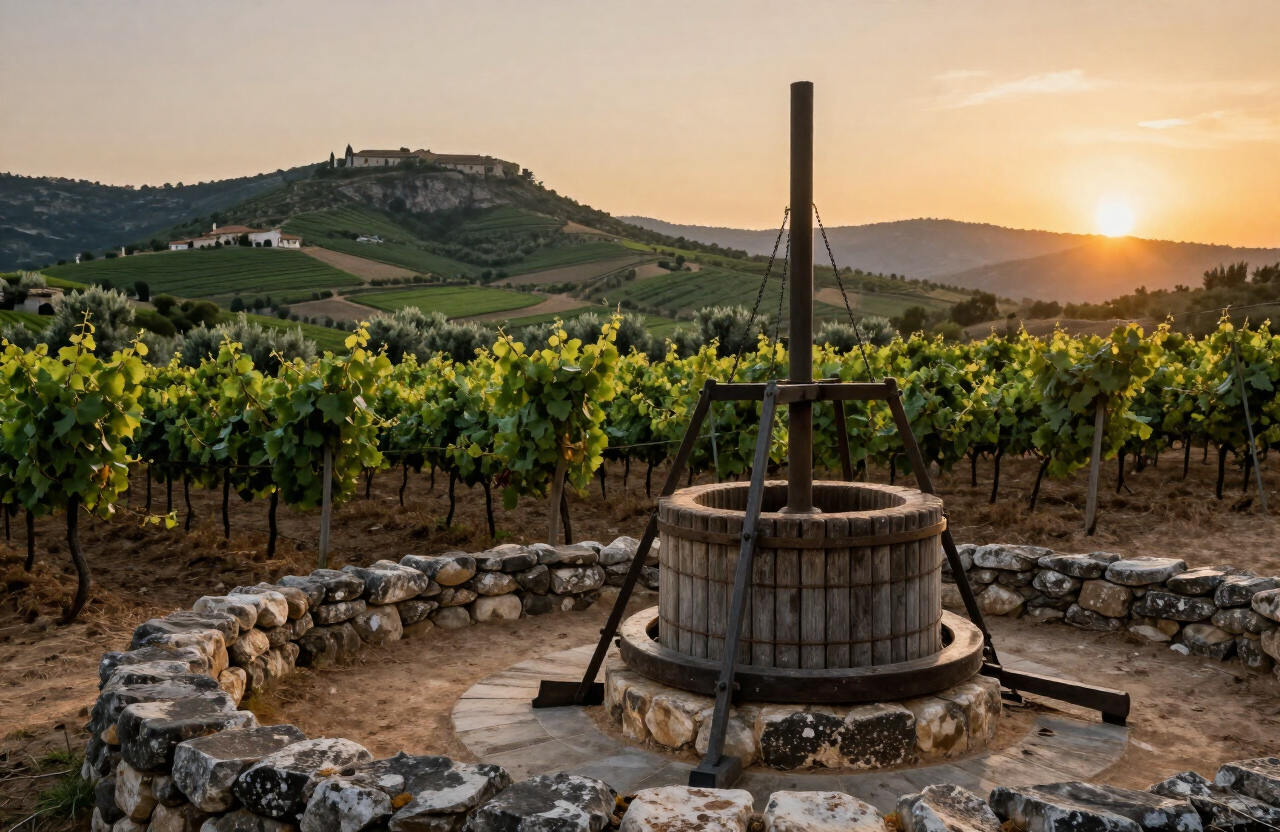
Wine has been made in Crete for close to four thousand years. The Minoans — Europe's first civilisation — pressed grapes here while the rest of the continent was still in the Bronze Age, and the island preserves one of the oldest known wine presses in Europe, cut into rock and still legible today. Clay storage jars, palace archives and trade seals show an organised wine economy that shipped across the eastern Mediterranean long before Athens existed.
The Venetians who ruled these islands for centuries built a luxury trade on Aegean sweet wine, shipping it north under the name of the Peloponnesian port it left from — the origin of the word Malvasia, which entered every European language as a byword for the finest wine money could buy. For medieval Europe, Greek wine was the benchmark against which everything else was measured.
Then came four centuries of Ottoman rule, phylloxera in the north, war, and emigration — and Greek wine slipped almost entirely out of the world's view. Its return is recent and remarkable: a generation of Greek winemakers trained abroad came home in the 1980s and 1990s, looked past international varieties, and rebuilt the industry on the native grapes their grandparents had never stopped growing. What was a footnote thirty years ago is now among the most exciting white-wine stories in Europe.
Sommelier Notes
Assyrtiko tasted at source is a different wine entirely — the salinity, the tension, the volcanic minerality that no bottle travelling north ever quite carries. This route is the most convincing case for Greek wine I know.
Head Sommelier — Aegean cellar programme
Crete's hospitality is the product as much as the wine. The long table on the mountain estate, with varieties grown nowhere else, was the evening our group still talks about.
Wine Director — Private client travel
Interesting Facts
- ◈
Santorini's vines are among the oldest ungrafted vines on earth — phylloxera cannot survive in the island's volcanic ash and pumice, so root systems here can be centuries old.
- ◈
Because of the ferocious wind, vines are woven by hand into low basket shapes called kouloura, with the fruit sheltered inside the nest.
- ◈
It barely rains on Santorini in the growing season. The vines drink from sea mist that condenses on the leaves overnight.
- ◈
Vinsanto is made from sun-dried grapes and aged for years in barrel — a sweet wine of the same lineage the Venetians traded across Europe.
Things That Make This Region Extraordinary
Six reasons this route is unlike any other.
Santorini's vines are among the oldest ungrafted vines on earth — phylloxera cannot survive in the island's volcanic ash and pumice, so root systems here can be centuries old.
Because of the ferocious wind, vines are woven by hand into low basket shapes called kouloura, with the fruit sheltered inside the nest.
It barely rains on Santorini in the growing season. The vines drink from sea mist that condenses on the leaves overnight.
Vinsanto is made from sun-dried grapes and aged for years in barrel — a sweet wine of the same lineage the Venetians traded across Europe.
Crete holds one of the oldest wine presses in Europe, roughly 3,500 years old.
Several near-extinct Cretan grape varieties were rescued from a handful of surviving vines and are now bottled again.
In the Glass
What you will be drinking.
Assyrtiko is the reason serious buyers come: bone-dry, saline, with the structure of a great white and acidity that survives a decade. Beside it, Crete offers softer, food-shaped whites and reds from varieties grown almost nowhere else on earth.
Grapes
Assyrtiko + Cretan natives
Character
Volcanic + island
Vinsanto from sun-dried grapes, aged for years in barrel, drunk as the sun goes into the caldera — that is the closing tasting every serious buyer should experience once.
Cellar Master — Cycladic vertical tasting
The Journey
How the days unfold.
Days on Crete belong to the mountain vineyards and long tables — the island's hospitality is the product as much as the wine. Then the crossing, and a complete change of register: black terraces, whitewashed cliffs, caldera light, and a closing tasting as the sun goes into the sea.
Best suited to
Curious food-and-wine groups
Duration
6 days / 5 nights
When to go
May–Jun · Sep–Oct
More to know
Further facts from the route.
Crete holds one of the oldest wine presses in Europe, roughly 3,500 years old.
Several near-extinct Cretan grape varieties were rescued from a handful of surviving vines and are now bottled again.
Continue exploring
The other nine routes across Europe.
Begin here
Your Crete + Santorini journey, designed privately.
Tell us the route, the group and the season. We return a complete private itinerary within 48 hours.